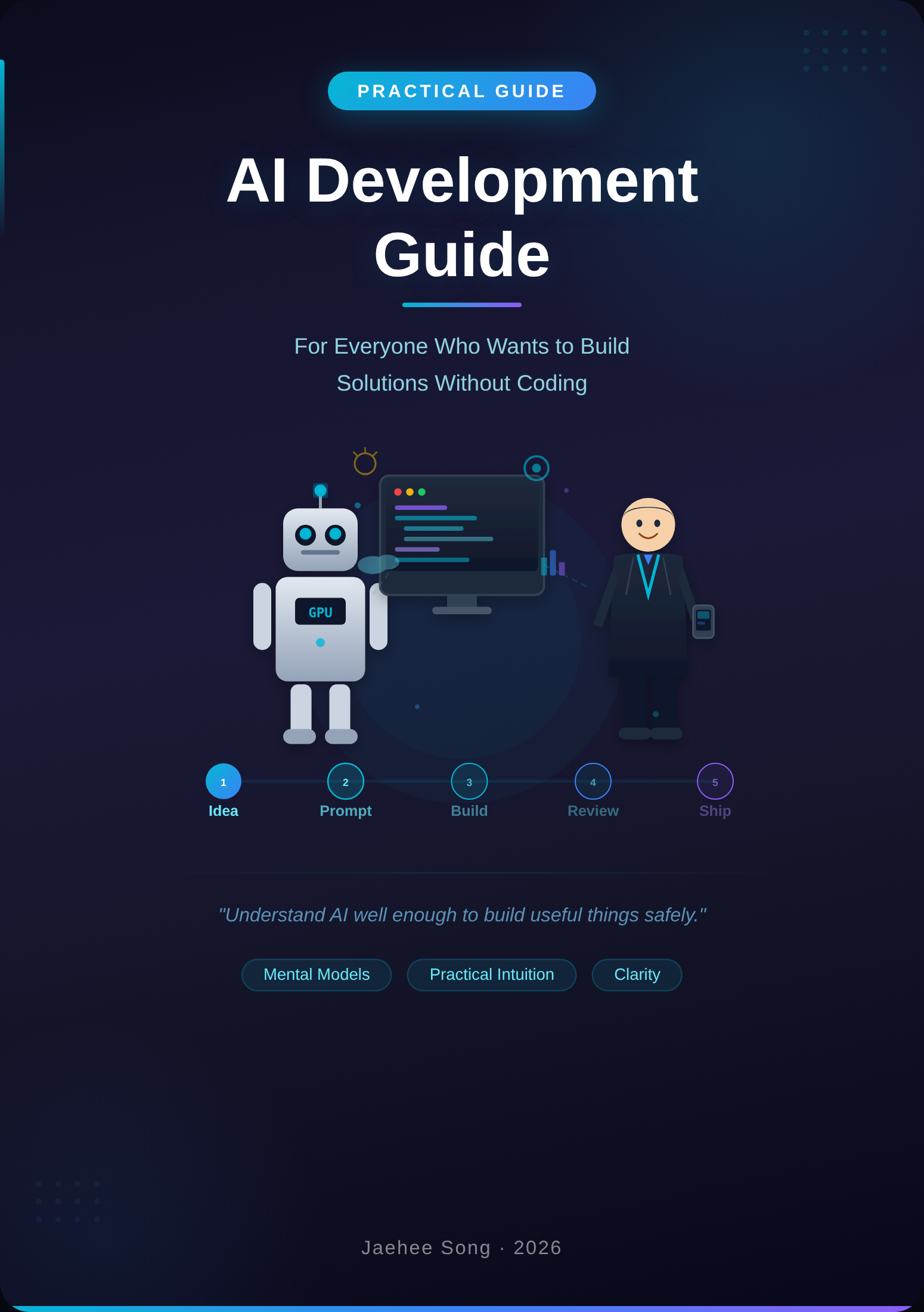
AI Development Guide
For Everyone Who Wants to Build Solutions Without Coding
AI Development Guide is a 2026 practical book that teaches non-developers to build real AI-powered software using vibe coding, prompt engineering, and AI agents — without writing code.
Mental models before tools. Practical intuition over theory. Clarity over completeness.
Something Big IS Happening
But panic isn't a strategy.
Matt Shumer's essay just crossed 80 million views. Fortune syndicated it. Gary Marcus called it "weaponized hype." The internet is divided.
Here's what both sides agree on: if you haven't started using AI seriously in your work, you're already behind.
Most people ARE using AI. They've tried ChatGPT, Claude, Copilot. They've asked it questions, generated some content, maybe even built a quick prototype. And yet… they're stuck. The results are inconsistent. The outputs look impressive for five minutes, then fall apart. The gap between the demos they see online and their actual experience feels enormous.
That frustration — between using AI and actually getting real value from it — is exactly why I wrote this book.
I've spent 20+ years as a data platform architect at companies like Visa. I've watched every major tech wave. And the pattern is always the same. According to Gartner's latest research, by 2028, 75% of enterprise software engineers will use AI code assistants daily — yet most organizations still lack practical frameworks for non-technical teams to participate.
- The technology arrives
- The hype explodes
- The practical guidance? It exists — but it's scattered across YouTube tutorials, blog posts, and Twitter threads. Each one covers a narrow slice. Prompt tips here. A coding demo there. Nothing ties it together into a complete framework for actually thinking through what to build and how to build it right.
Shumer is right that AI can now build software from plain English descriptions. Marcus is right that it still makes mistakes and hallucinates. Both things are true simultaneously.
What's missing from this debate is the middle ground — the practical thinking that turns AI from a frustrating toy into a real tool for your work.
That's what AI Development Guide is about.
Everyone Can Be a Builder. Starting Now.
This book gives you the mental models, practical skills, and real-world knowledge to build AI-powered solutions — no coding experience required.
Mental Models First
Understand how AI actually works — its strengths, weaknesses, and realistic capabilities. No jargon, no hype. Just clear thinking frameworks you can apply immediately.
Build Without Code
From prompt engineering to vibe coding, learn to create real, working software by describing what you want in plain language. The AI handles the implementation.
Real-World Production
Go beyond demos. Learn cost management, scaling strategies, security practices, and responsible AI use for solutions that actually work in the real world.
AI Development Guide vs. Other Ways to Learn AI
Not all AI learning resources are built the same. Here's how this book stacks up.
| AI Development Guide | Typical AI Course | Technical AI Book | |
|---|---|---|---|
| Prior coding required? | No | Sometimes | Yes |
| Focus | Mental models + build | Tool-specific | Theory / algorithms |
| Production skills? | Yes (Ch 12–14) | Rare | Sometimes |
| Audience | Founders, business owners, career changers | Developers | CS students |
| Cost | One-time purchase | Subscription | One-time purchase |
What Is Vibe Coding?
Vibe coding is a software development approach where you describe what you want to build in plain English, and AI generates the code for you.
According to Collins Dictionary, which named it Word of the Year in 2025, vibe coding lets non-developers create full-stack applications, websites, and automation tools using natural language prompts. Instead of memorizing syntax, you learn to communicate intent clearly to AI tools like ChatGPT, Claude, Cursor, and Replit.
The key insight: vibe coding shifts the builder's job from typing code to describing problems, reviewing outputs, and iterating — skills that domain experts and business owners already have.
How to Build Apps Without Coding Using AI
- Start with a clear problem. Define what you want the app to do in one sentence. The more specific, the better the AI output.
- Choose your tool. Use vibe coding platforms like Cursor, Bolt, Replit, or Lovable.
- Describe the solution. Write a detailed prompt explaining features, layout, and behavior.
- Review and iterate. Test the generated app, give feedback, and refine.
- Deploy and maintain. Use hosting services like Vercel or Netlify to go live.
This book teaches each step in depth — including how to handle errors, manage costs, and scale from prototype to production.
What You'll Learn
A complete learning path from understanding AI to building production solutions.
Understanding AI
- Ch 1 The Mental Model of AI
- Ch 2 How AI Thinks — Strengths, Weaknesses, and Reality
- Ch 3 The Modern AI Stack — The LEGO Model
Working With Data & Prompts
- Ch 4 Data — The Fuel (Often the Real Problem)
- Ch 5 Organizing Data for AI
- Ch 6 Prompting Is Programming (For Everyone)
- Ch 7 AI Agents & Workflows
Building Solutions
- Ch 8 You're Already Programming
- Ch 9 Automating Work Without Code
- Ch 10 Building Real Services with Vibe Coding
- Ch 11 Code Assistants
Going to Production
- Ch 12 The AI Development Lifecycle
- Ch 13 Cost, Performance, and Scaling
- Ch 14 Risks, Limitations, and Responsible Use
- Ch 15 AI Glossary — Plain English
Written for Builders, Not Developers
Whether you're running a business, launching a startup, or changing careers — this book meets you where you are.
Small Business Owners
"I can't afford a dev team, and my ideas are stuck in a queue."
Become your own technology department.
Non-Technical Founders
"I need an MVP but I don't have a technical co-founder."
Build your first version yourself.
Domain Experts
"I see problems every day that software could solve."
Build exactly what your field needs.
Career Changers & New Grads
"I need to prove I can build things, not just talk about them."
Create a portfolio of real solutions.
The biggest barrier to becoming a builder isn't technical skill. It's the belief that building requires technical skill.
— AI Development Guide
Jaehee Song

Start Building Today
Available on all major platforms.
Questions, Suggestions, Feedback?
I'd love to hear from you. Whether it's a question about the book, a suggestion for future content, or just feedback on your experience — drop me a line.
✉️ jsong@koreatous.comFrequently Asked Questions
Common questions about AI development, vibe coding, and what's inside the book.
What is vibe coding and how does this book teach it?
Vibe coding is a new approach to software development where you describe what you want to build in plain English and AI generates the code. Named Collins Dictionary's Word of the Year in 2025, vibe coding lets non-developers create full-stack applications, websites, and tools using natural language prompts with tools like ChatGPT, Claude, Cursor, and Replit. This book dedicates an entire chapter to building real services with vibe coding, complete with hands-on examples.
Do I need coding experience to build AI-powered solutions?
No coding experience is required. AI Development Guide is specifically written for non-developers — business owners, founders, domain experts, and career changers who want to build real software using AI. The book teaches you to use prompt engineering, vibe coding, and AI agents to create working applications by describing what you need in plain language.
What is prompt engineering and why does it matter in 2026?
Prompt engineering is the skill of crafting effective inputs to guide AI models like ChatGPT, Claude, and Copilot to produce useful outputs. In 2026, with AI agents and agentic workflows becoming mainstream, prompt engineering has evolved from simple chatbot interactions to designing complex AI workflows. This book teaches prompt engineering as a practical skill for building real solutions, not just generating text.
What are AI agents and how do I build them without coding?
AI agents are autonomous AI systems that can plan, execute tasks, use tools, and make decisions with minimal human input. Unlike simple chatbots, agents can perform multi-step workflows like researching, analyzing data, and taking actions. This book covers AI agents and workflows in Chapter 7, teaching you how to design and deploy agentic systems using no-code and low-code approaches.
How is this different from other AI books?
Most AI books are either too technical (written for developers) or too surface-level (just ChatGPT tips). AI Development Guide bridges the gap with a complete framework — from AI mental models and data foundations to prompt engineering, vibe coding, AI agents, and production deployment. Written by a 20+ year enterprise architect at Visa who has trained 200+ students, it gives you practical, real-world knowledge rather than just theory.
Can I really build production software without coding using AI?
Yes. In 2026, vibe coding tools like Cursor, Bolt, Replit, and Lovable can generate full-stack applications from natural language descriptions. However, building production-quality software requires understanding the AI development lifecycle, cost management, scaling strategies, and responsible AI practices — all of which this book covers in its final chapters.
What AI tools and platforms does the book cover?
The book covers the modern AI ecosystem including ChatGPT, Claude, Gemini, v0, Lovable, and other large language models (LLMs). It teaches prompt engineering techniques, vibe coding with AI code assistants, building AI agents and workflows with tools like n8n and Make.com, working with RAG (Retrieval Augmented Generation), and understanding concepts like tokens, context windows, and AI hallucinations — all in plain English with a plain-language AI glossary.
Who should read AI Development Guide?
This book is for anyone who wants to build AI-powered solutions but doesn't have a technical background: small business owners who can't afford dev teams, non-technical founders building MVPs, domain experts who see problems software could solve, and career changers entering the AI field. If you've used ChatGPT but feel stuck getting real value from AI, this book is for you.